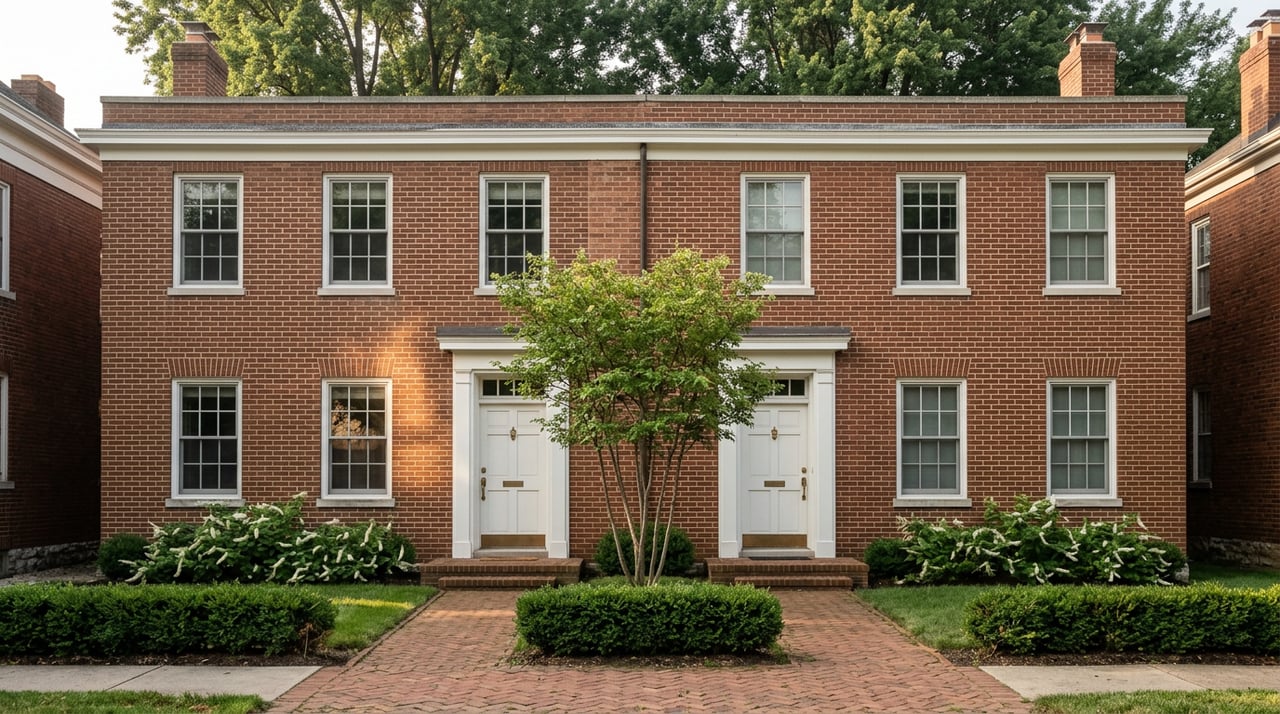
Three years ago, Arlington County did something only a handful of places in the country had tried. It opened every single-family lot in the county to duplexes, triplexes, and small multi-unit buildings, by right, with no separate rezoning hearing required. County planners projected the change would add roughly 100 new homes a year to a housing supply that has not kept pace with demand for decades.
As of last fall, only two of those homes had been finished and sold.
That is not because builders lost interest. It is the result of a lawsuit that has now spent more than three years moving through Virginia's court system, with a fresh appeal still pending, and it is the fact most house hunters comparing Arlington to Bethesda, Chevy Chase, or Potomac never see, because it lives in county permit data and court filings rather than in a listing description.
What the Zoning Change Actually Allows
In March 2023, the County Board voted unanimously to adopt the Expanded Housing Options ordinance, widely known as Missing Middle. The rule took effect July 1, 2023, and it let property owners build duplexes, semi-detached homes, townhouses of up to three units, or small multi-family buildings of up to six units on lots that had been restricted to one detached house. To manage the pace of change, the county capped approvals at 58 permits a year for the first five years, a rollout planners expected would yield 94 to 108 new housing units annually.
Board Chair Christian Dorsey called it a way to permit, by right, "options for different housing types in every residential zoning district," after a public process that drew thousands of comments over four years of study.
The Lawsuit That Froze the Rollout
Eleven Arlington homeowners filed suit the following month, arguing the county had skipped required environmental and infrastructure review. The case worked through the courts on this timeline:
| When | What happened |
|---|---|
| April 2023 | Eleven homeowners sue to overturn the ordinance |
| September 2024 | A Circuit Court judge voids the ordinance; the county cancels every issued permit |
| June 24, 2025 | The Virginia Court of Appeals reverses the ruling and reinstates EHO |
| October 1, 2025 | Arlington resumes accepting and reviewing EHO applications |
| May 20, 2026 | The Virginia Supreme Court agrees to hear a further appeal, on a developer's right to intervene in the case, not on the ordinance's merits |
Reporting on the September 2024 ruling noted that the judge found the county had not studied likely infrastructure effects before adopting the change, a procedural finding that had nothing to do with whether the housing itself was a good idea, but that stopped every project in the county cold for close to a year. One builder who had two projects under construction when the permits were voided has described paying $25,000 a month in carrying interest while the case sat in limbo, and eventually mortgaging his own house to keep going, according to reporting in Arlington Magazine.
The Math That Decides Whether "Missing Middle" Means Affordable
Here is the part that rarely makes it into the zoning debate: whether a Missing Middle project is actually affordable has almost nothing to do with the zoning designation and everything to do with how many units the land cost gets divided across.
Take a case documented by Greater Greater Washington: a century-old house north of the Virginia Square Metro, on a lot that last sold for $829,000, is being replaced by a six-unit building. Split six ways, the land cost per home drops to roughly $138,000, low enough that the new three-bedroom units are projected to price in the mid-$800,000s to high-$900,000s, potentially below the $913,000 the old single house sold for in 2022.
Now compare that to a duplex, which only splits the land cost in half. Custom homebuilder David Tracy, who does a lot of work in Arlington, put the basic problem plainly: "There's a relationship between the price of the lot, the cost of construction and the overall sales price," and Arlington land runs $800,000 to $1 million or more for under a quarter acre. Cut that in half instead of six ways and the math stops producing a bargain. Arlington real estate agent Kathy Rehill pointed to Halls Hill, one of the county's historically Black neighborhoods, as an early example of what that looks like on the ground: modest single-family homes being torn down for duplexes she estimated would list between $1.4 million and $1.8 million per unit.
Same ordinance. Same by-right approval. Two-unit buildings and six-unit buildings land in entirely different price categories, because the arithmetic is different, not because the policy is.
What's Actually Been Built
The county's own first-year data, covering July 2023 through June 2024, gives a sense of scale. Thirty-seven EHO zoning permits were approved in that first fiscal year, covering 145 units. The average EHO unit came in at 1,646 square feet, more than three times smaller than the average newly permitted single-detached house at 5,259 square feet. Of those 145 units, 43 percent were three-bedroom, a size that did not exist among new single-detached permits that year at all, according to the county's EHO Annual Data Report.
Permits are not homes, though. Sixty-six percent of the annual permit allotment is reserved for the R-6 zoning district, the county's most common single-family category, but between the litigation halt and the time it takes to design, permit, and build, only two new-construction EHO projects had reached completion by last fall: a duplex in North Highlands and one in Claremont. Dozens more sit somewhere between a permit and a certificate of occupancy.
A Provision Built for a Different Kind of Decision
One detail in the ordinance rarely comes up outside planning documents, and it is worth knowing if you are further along in life and weighing whether to sell a longtime home rather than reshape it. Under Option 8A, a single-family homeowner can convert their own house into a multi-unit EHO building as a matter of right. County planning documents describe this option as a response to residents who want to age in place by restructuring their home rather than leaving the neighborhood entirely.
That is not a recommendation to convert a house, and every property's zoning eligibility and physical layout are different. It is simply a fact worth having if you own an older single-family home in one of Arlington's EHO-eligible zones and are trying to figure out whether your only options are staying exactly as things are or selling to move on.
Comparing Arlington to Bethesda, Chevy Chase, or Potomac Right Now
If you are shopping across the DC area and treating "Arlington has Missing Middle now" as a reason to expect a wave of moderately priced new construction, the current market does not support that yet. Over the three months ending in May 2026, Arlington's median sale price sat at $835,000, up 4.4 percent year over year, with homes selling in around 28 days and buyers making an average of three offers, according to Redfin. Broken out by type, condos have been averaging around $475,000 while single-family homes average close to $1.4 million, with only 431 homes on the market as of March 2026, a tight supply that has kept sellers in the stronger negotiating position, per Houzeo's market tracking.
That gap between attached and detached pricing is close to the same gap that existed before the ordinance passed. Single-family homes make up about a quarter of Arlington's housing stock but occupy nearly 80 percent of its residential land, while duplexes and townhouses account for only around 6 percent, a mismatch the zoning change was designed to correct over time. Three years in, with two completed projects and an active court case, that correction has barely started.
None of this means the reform failed or that it will not eventually change what is available. It means that if you are comparing Arlington's inventory to Bethesda's condo stock or Potomac's larger detached lots, you should be pricing today's actual market, not the market a headline about ending single-family zoning might have led you to expect.
A Few Questions Worth Asking
Does this zoning change apply to every property in Arlington? Not every lot. Properties inside certain planning districts identified on the county's General Land Use Plan are excluded, and permit allotments are split unevenly across zoning categories, with R-6 receiving the largest share. Confirming a specific address's eligibility requires checking with the county directly.
Is the lawsuit resolved? Not fully. The Virginia Court of Appeals reinstated the ordinance in June 2025 and the county resumed processing applications that October, but as of May 2026 the Virginia Supreme Court has agreed to hear a further appeal on a procedural question about who was entitled to participate in the original case. The underlying merits of the ordinance are not part of that appeal.
Should I expect prices to drop because of this? The evidence so far points to a range rather than a single outcome. Where land can be split across five or six units, prices can land meaningfully below new single-family construction. Where a lot only supports a duplex, the per-unit price can land above what many buyers were hoping the reform would deliver.
Whether you are trying to make sense of a specific Arlington listing, weighing what a longtime home in an EHO-eligible zone might mean for your options, or simply comparing what your budget buys across the DC area's different neighborhoods, it helps to talk through the specifics with someone who follows these changes closely. Next Step Living works with people at exactly this kind of decision point, whether that means understanding a zoning question before you buy or thinking through what a long-held property is actually worth in today's market. Contact us when you are ready to talk it through.